The aim of this article is to show a technical guidance on the selection of anti vibration mounts for gensets. This article will show the different positions where the mounts can be installed on a genset, and which ones are the ones that technically are more correct.
1- Necessary technical information for the selection of a correct anti vibration mount of a genset.
- A: Total weight of the genset
- B: Position of centre of gravity
- C: Position of the mounts respect to the centre of gravity
- D: Disturbing frequency
- E: Engine model
This basic information will allow us to make a single degree of freedom calculation. The following link provides a questionnaire that facilitates the introduction of such data and allows the technical department of AMC-MECANOCAUCHO to make a calculation of such type.
Click on this link to download the questionnaire. As this document contains javascript, please don't open it into the web browser, as it disables its capabilities. Please use Adobe Reader.
Due to the simplification of the mathematical model, the results of such kind of calculations must be understood as guidance recommendation only. When high reliability of calculations is required, it is advisable to perform a calculation that takes into account all the degrees of freedom of the suspended element. For this purpose, these additional elements would be required:
- 3D drawing of the suspended element
- Moments of inertia in X, Y and Z
This type of calculation provides us natural frequencies of the system and the eigenvectors.
The eigenvectors allow us to understand the vibration modes of the system. This information allows AMC-MECANOCAUCHO applications engineers to optimize the suspension and recommend an anti vibration mount that will provide a transmissibility curve where the natural frequencies are far from the disturbing frequencies of the genset.

Recommendation on the optimum position of the antivibation mounts for vibration isolation purposes
- 2.1- Possible positions of mounts within a genset:
- 2.1.1- Between genset and Frame. At this point, depending on the size of the genset, single or multiple pairs of mounts can be used under the engine or alternator.

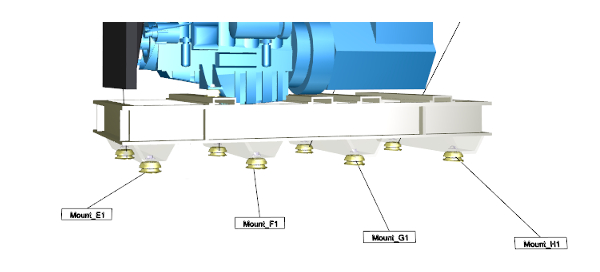
- 2.1.2- Beneath the frame.
- 2.1.3- Double mass isolation system

- 2.2- Optimum positions for isolation and stability purposes. The correct stability is achieved with the correct positioning of mounts respect to the centre of gravity.
Mounts equally loaded and positioned at the height of the crankshaft allow stable suspended elements and uncoupled vibration nodes.
When rigid mounts are installed between the genset and frame, noise interferences are likely to occur, especially if the frame is light and the metalwork is not reinforced. In order to avoid this problem, softer mounts are advisable.
When the main priority is the stability and noise created by the genset is not an issue, mounts under the frame can be used. On such kind of cases, when the mounts are correctly calculated, good vibration isolation ratios can be achieved.
The best isolation ratios are achieved using double mass isolation systems. If they are not properly designed, the result can be poor, creating amplification or lack of stability. We strongly recommend multiple degrees of freedom calculation at this point.
The technical department of AMC-MECANOCAUCHO can be of great help here.
Installations such as the one that follows, provide a good compromise between isolation and stability.
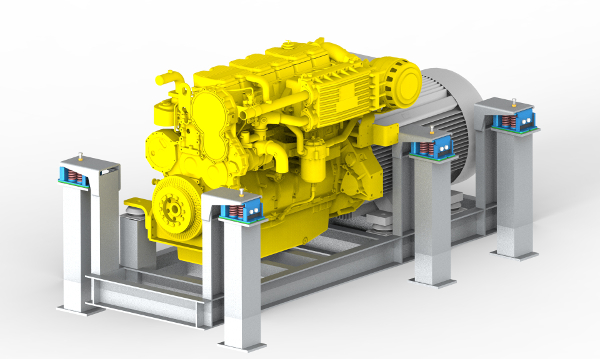

Nevertheless other constructions are possible and our technical department will be ready to advice and provide technical evidences and empirical results on similar cases.
Visit www.mecanocaucho.com where you will have the possibility to contact our engineering department. Click on this link to access the contact form on our website.


 United Kingdom


