AMC-MECANOCAUCHO participated in a new study presented at the Forum Acusticum Malaga 2025 congress, in collaboration with the acoustic engineering group AINS Group (Finland).
©2025 Lietzén et al. This is an open-access article distributed under the terms of the Creative Commons Attribution 3.0 Unported License.
The aim of this scientific article was to study the acoustic performance of different floor solutions in CLT (Cross Laminated Timber) buildings, comparing lightweight elastically mounted systems with traditional screed-based solutions.
Studied floor configurations
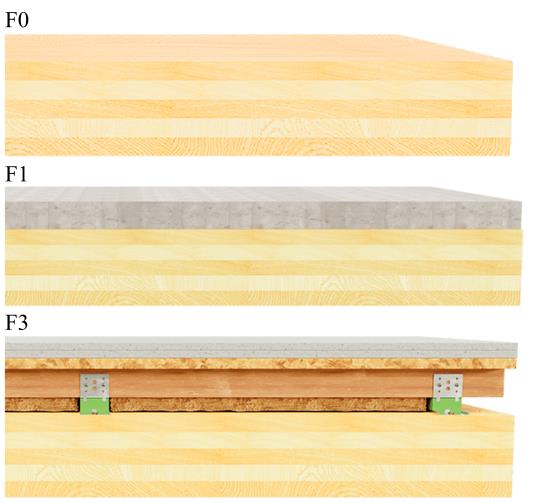
FEM and parametric models were used to compare the acoustic performance of elastically mounted floors (Akustik+Sylomer®) with traditional screed floors. The following configurations were evaluated:
|
Studied configurations: F0, F1, and F3.
- F0: Bare CLT 140 mm (reference).
- F1: 50 mm concrete screed + 3 mm elastic underlayer + CLT.
- F3: Elastically mounted floor (Akustik+Sylomer® 25) + OSB board + Fermacell panels + CLT.
|
Simulation methods and materials
Advanced simulation models were used to understand the phenomena affecting sound insulation. For frequencies between 50 and 250 Hz, the finite element method (FEM) was used. For higher frequencies (250–5000 Hz), parametric methods based on SEA and mechanical models were employed.
FEM Simulation Results
| CONFIGURATION F0 |
CONFIGURATION F3 |

|

|
Key results
- The elastically mounted floor (F3) provided the best overall acoustic insulation.
- Vertical improvement: up to +23 dB in DnT,w and -36 dB in L’nT,w vs. F1 (screed).
- Horizontal transmission between adjacent rooms was also significantly reduced thanks to decoupling.
- F1 (screed) offered limited improvement due to the stiffness of its elastic underlayer.
- FEM results matched field tests well, with minor deviations at low frequencies due to boundary conditions.
Conclusions
Akustik+Sylomer® solutions offer a high-performance and sustainable alternative to traditional screed-based floors. The data support their increased use in modern CLT construction.
©2025 Lietzén et al. This is an open-access article distributed under the terms of the Creative Commons Attribution 3.0 Unported License.


 United Kingdom


