Pipe Riser Isolation
Vibration isolators for the resilient isolation of riser pipes in high-rise buildings.
In high-rise buildings, riser pipes are subjected to significant loads as well as forces generated by pressure variations and the thermal expansion and contraction of the pipework.
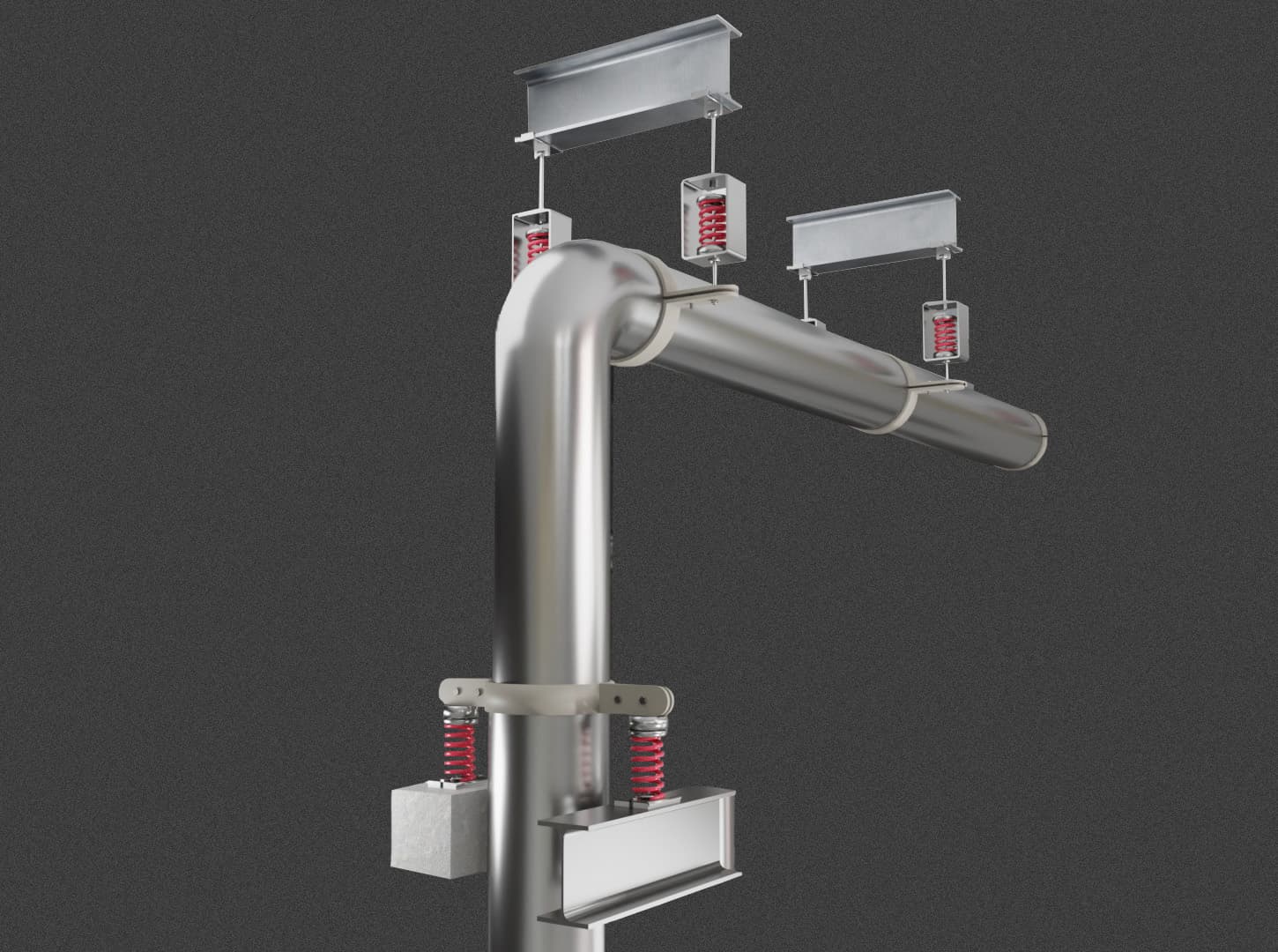
The use of spring isolators supports the pipe loads while allowing the movements required for correct operation. The resilient isolation also reduces the transmission of vibration and structure-borne noise to the building structure.
These systems are particularly suitable for HVAC, hydraulic and sanitary risers in high-rise buildings.
Technical characteristics
As buildings get taller, the complexity of pipe risers increases due to hydraulic forces, pressure changes, and thermal expansions. Past solutions involved the use of expansion joints or horizontal expansion loops, but these had reliability issues and required additional space.
A more efficient solution involves using spring mounts along the pipework, with the option of a fixed anchoring point. With a fixed anchoring point, the thermal expansion and contraction are absorbed by the spring isolators, while the anchored point remains in place. It's important to position the fixed anchoring point at the midpoint of the riser's total height to distribute the expansion evenly.
Alternatively, installations without fixed anchoring points are possible but not recommended for high demanding applications. The number, position, and types of supporting points are determined based on the maximum loads and temperature extremes. In addition to handling loads and thermal changes, the elastic supports also provide noise and vibration isolation for the building.
You might also be interested in