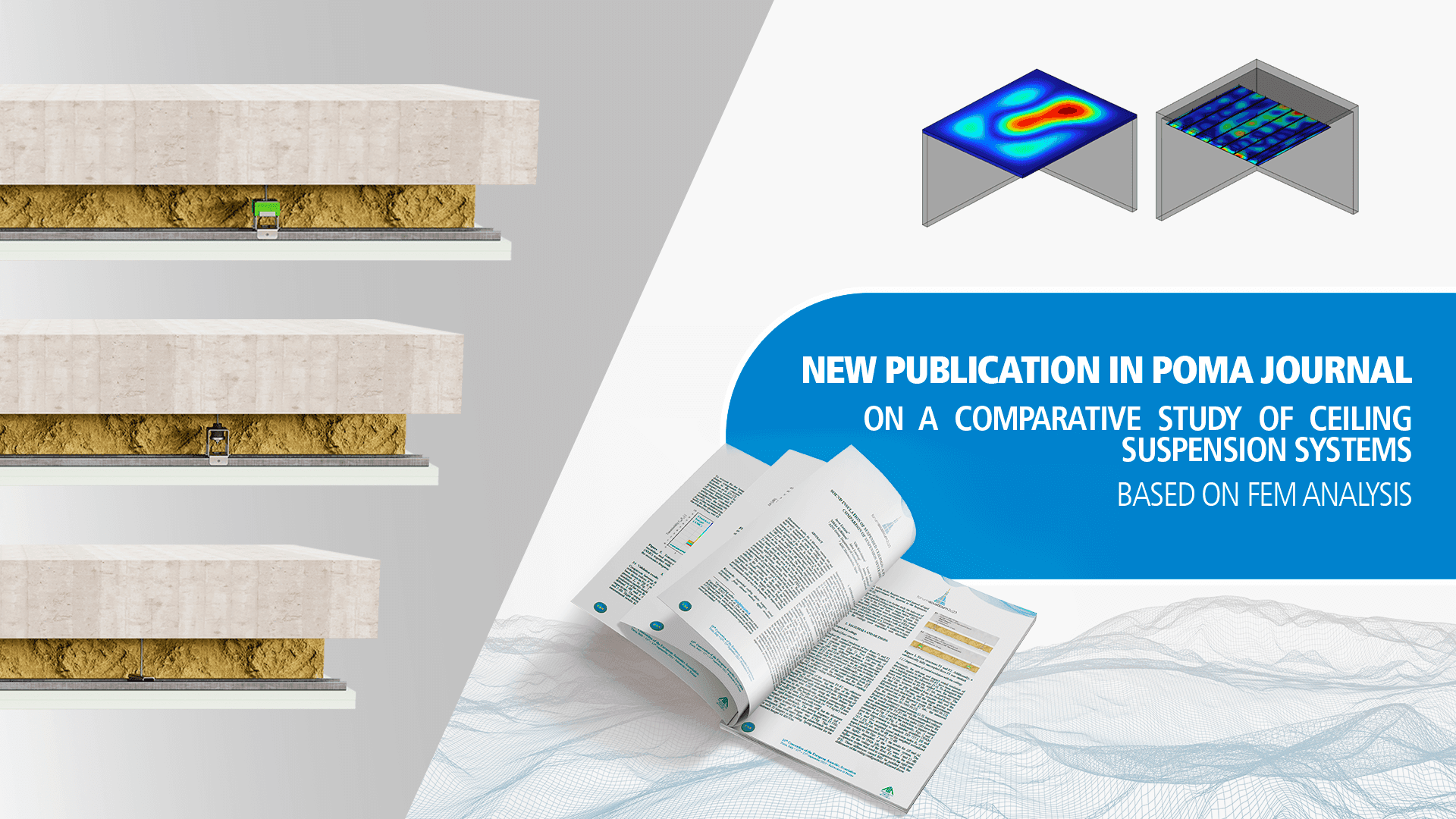
NEW PUBLICATION IN POMA JOURNAL ON A COMPARATIVE STUDY OF CEILING SUSPENSION SYSTEMS BASED ON FEM ANALYSIS
This society serves as a platform for presenting papers and research findings from meetings and conferences organized by the society itself. The POMA journal, which covers a wide range of topics related to acoustics, helps researchers, engineers, and professionals in the field of acoustics to share their work and stay updated on the latest advancements and developments in the discipline.
In this case, the published study focuses on the comparison of ceiling suspension systems based on FEM analysis. This work has been developed by the AINS group from Finland in collabotion with AMC MECANOCAUCHO®. Below, we present the conducted study.
FEM + Parametric methods help to compare the acoustic results using Akustik+Sylomer hangers vs ceilings without mechanical coupling.
Copyright: ©2023 Lietzén et al. This is an open-access article distributed under the terms of the Creative Commons Attribution 3.0 Unported License, which permits unrestricted use, distribution, and reproduction in any medium, provided the original author and source are credited. Authors. Jesse Lietzén, Ville Kovalainen, Lauri Talus, Mikko Kylliäinen, Ander Aldalur and Aitor Lopetegi. 1 AINS Group, Department of Acoustical Engineering, Finland 2 AMC Mecanocaucho, Spain
The purpose of this scientific paper was to study the behavior of differently suspended ceilings and to compare the effect of different hangers on the low-frequency sound insulation.
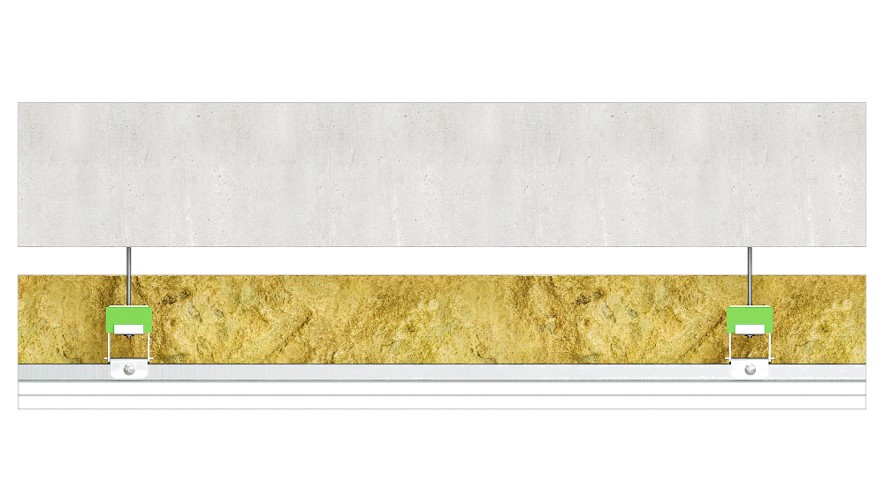
As a preface we must start by describing the composition of a suspended ceiling.
|
|
The coupling between the suspended ceiling and the bearing slab is mechanical (through suspension) and acoustical (through airspace).
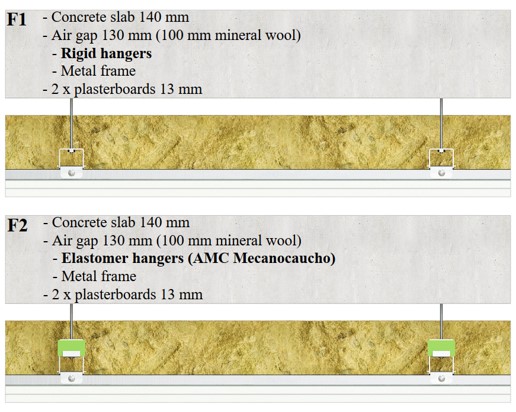
The following floor structures were examined in the study:
|
Studied floor structures F0–F3: |
Previously, the airborne and impact sound insulation of structures similar to the floors F0–F2 have been measured by a building acoustics laboratory
|
|
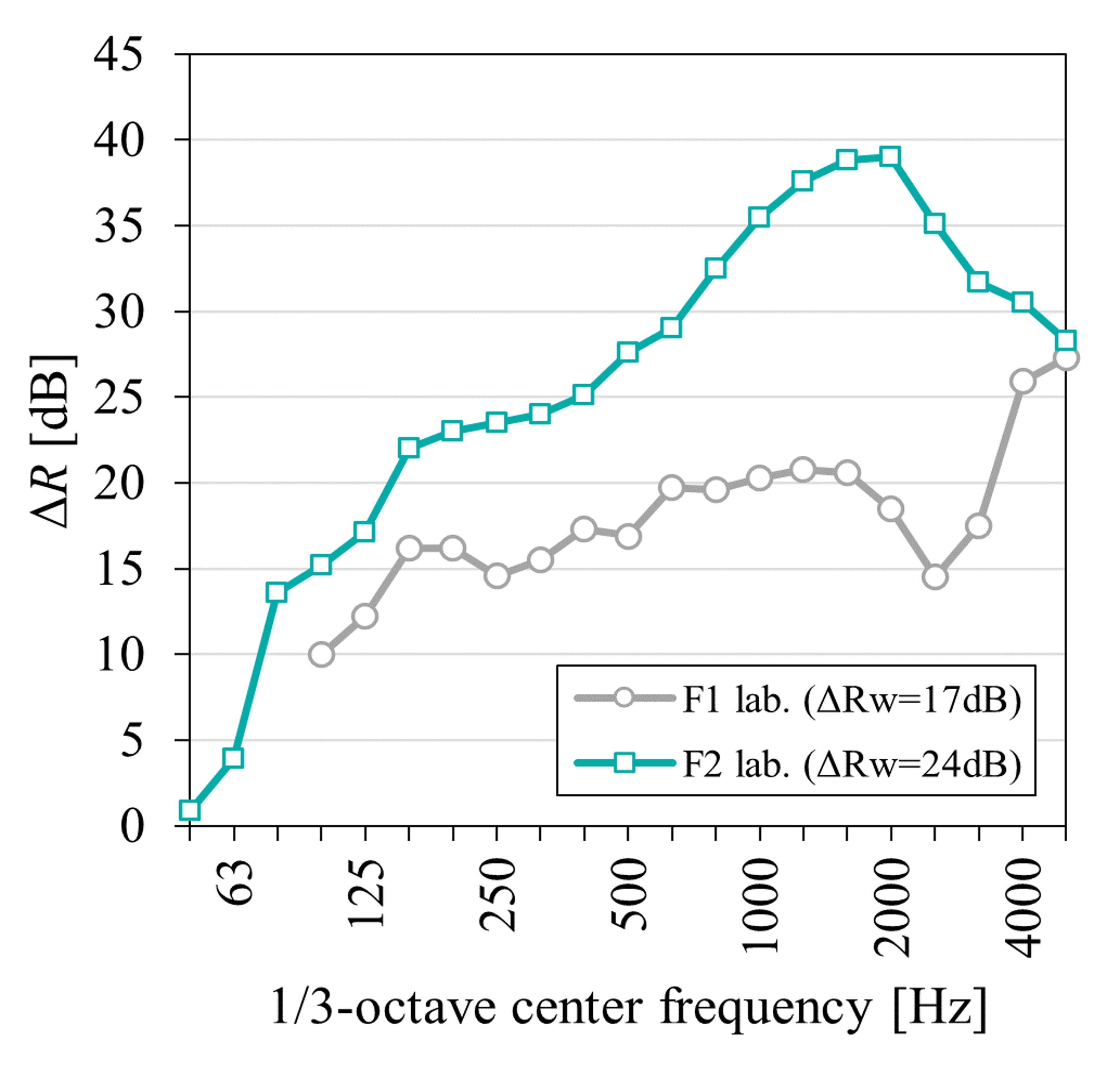
Figure 2. Measured improvement of sound reduction index ΔR and ΔRw for the ceilings of the floor structures F1–F2 lab. |
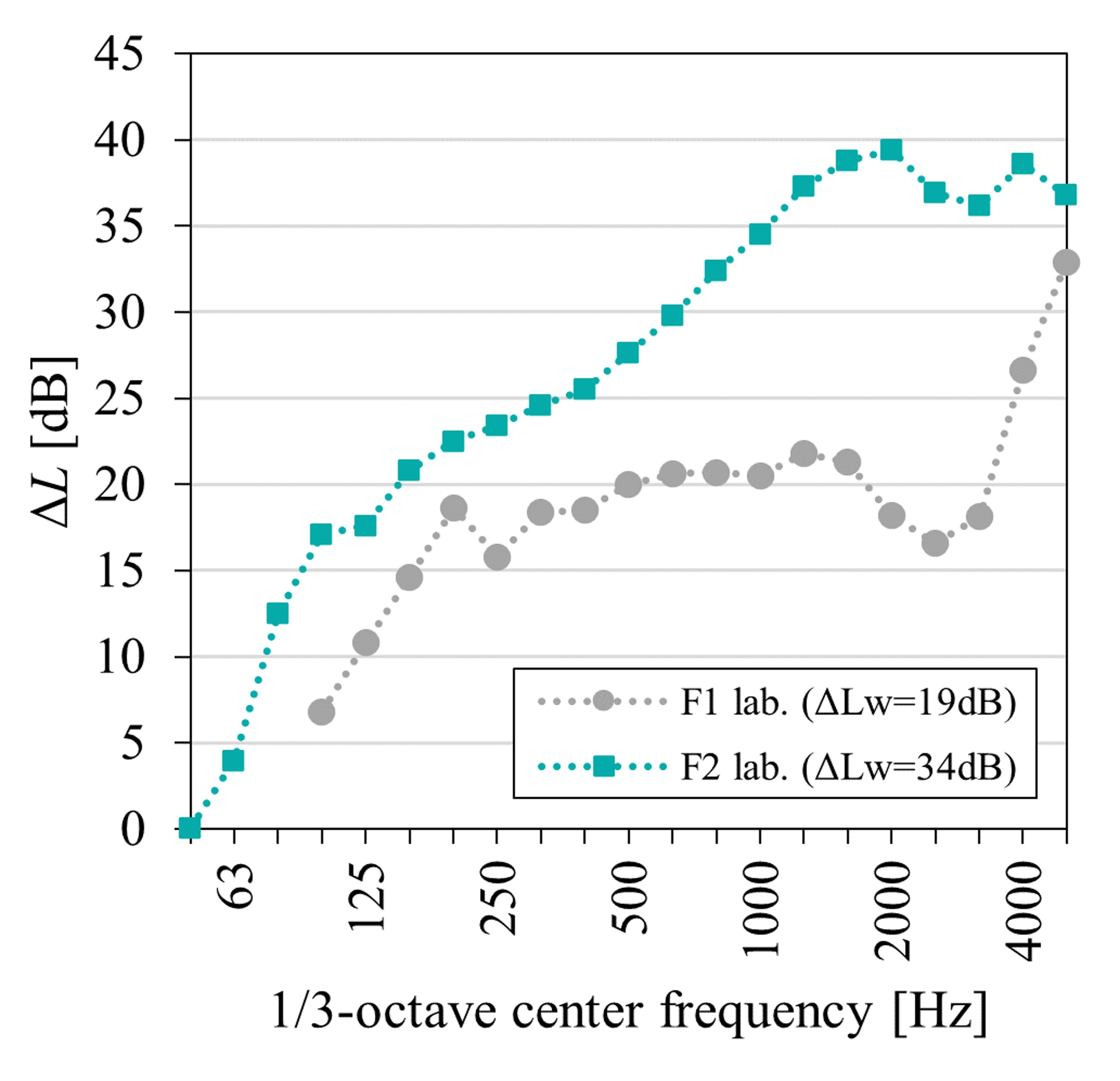
Figure 3. Measured reduction in impact sound pressure level ΔL and ΔLw for the ceilings of the floor structures F1–F2 lab. |
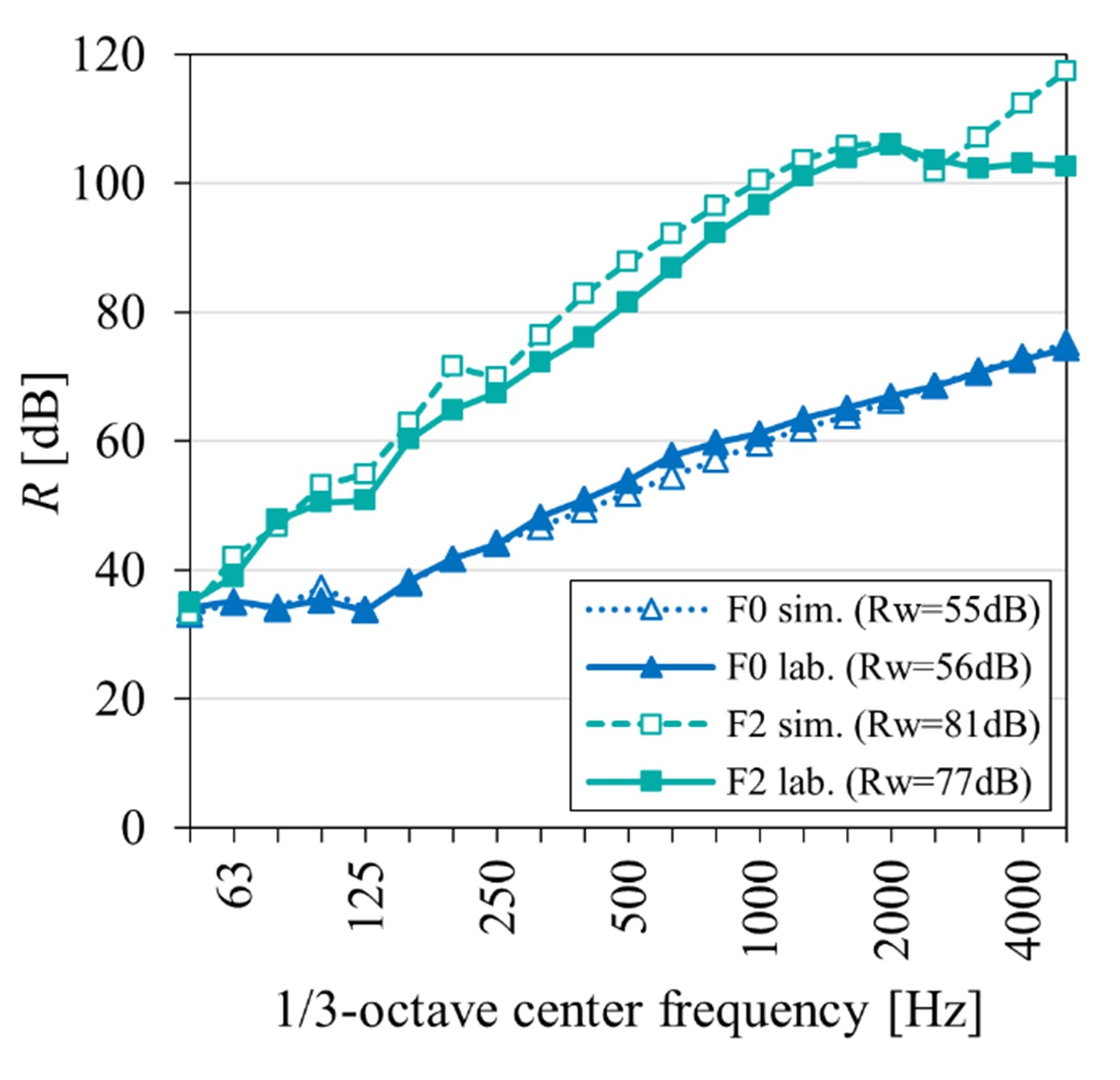
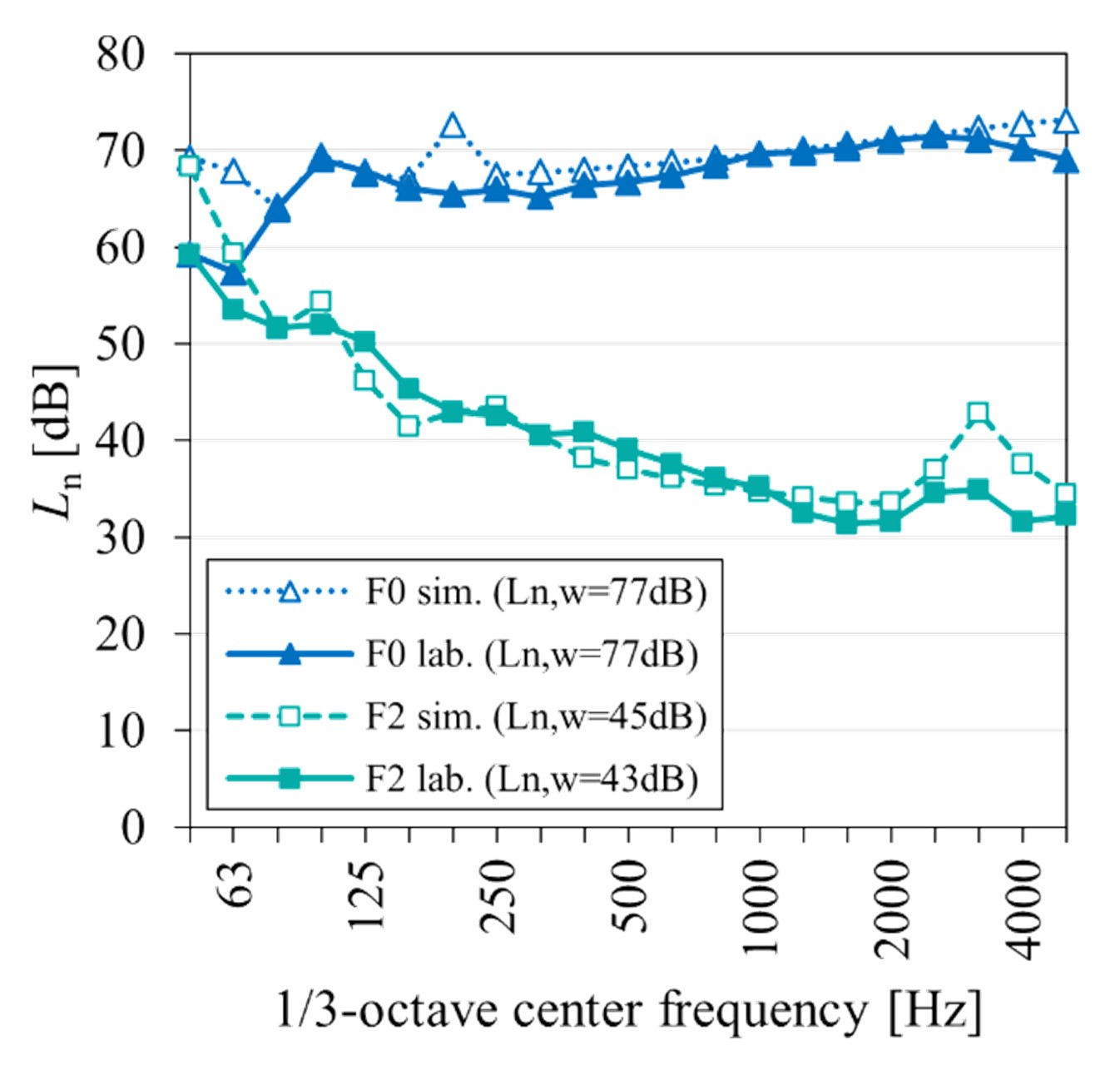
The weighted sound reduction index Rw of the bare slab F0 lab. was 56 dB and the weighted normalized impact sound pressure level Ln,w 77 dB. According to the Figs. 2 and 3, the results for ΔR and ΔL are highly dependent on the suspension system. The improvements in SNQs ΔRw and ΔLw were 7 and 15 dB higher for the ceiling of the floor F2 where the elastic suspension system was used in comparison to the rigid one.
SIMULATION METHODS AND MATERIALS.
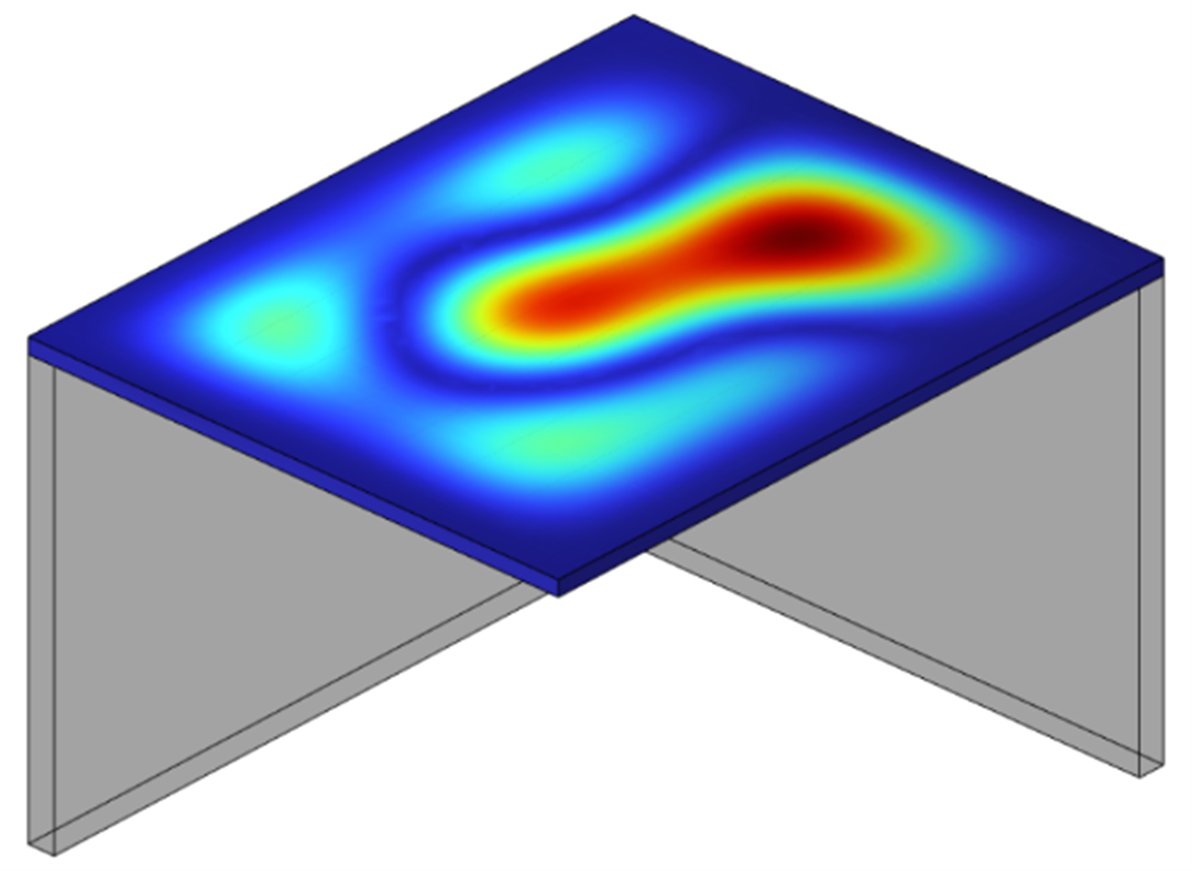
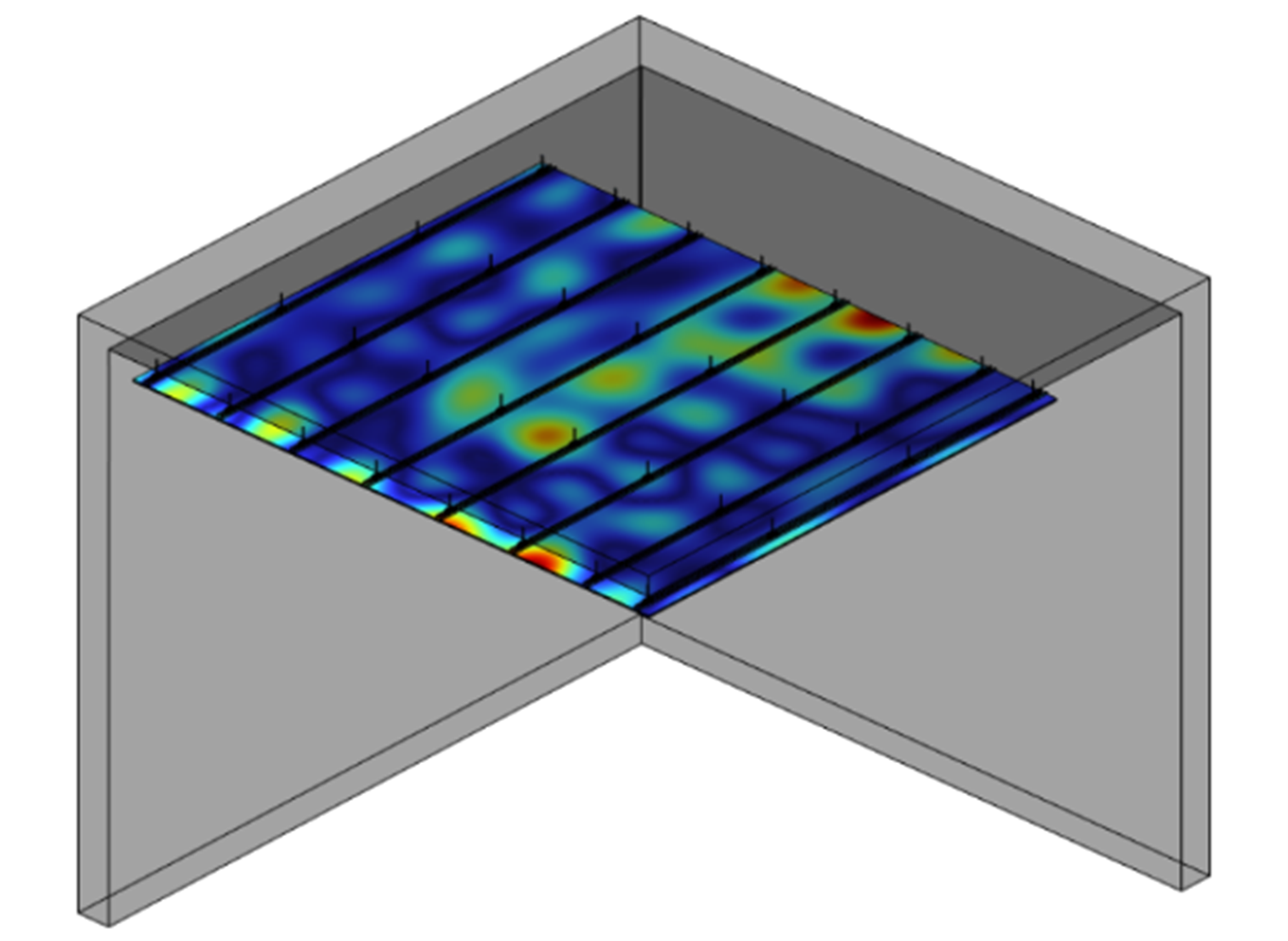
Simulations were applied to study the phenomena affecting the airborne and impact sound insulation of the three different suspension systems. For frequencies in the range of 50-250 The calculation results from the FEM model were used to examine the performance of the ceiling at low frequencies. For frequency ranges 250–5000 Hz Parametric calculation methods based mostly on SEA, lumped mechanical models and/or forced transmission approaches were used.
FEM simulations were performed in frequency domain. Ceiling hangers were considered as spring-damper components with the following natural frequencies.
Rigid hangers: f0 322.5 Hz.
Elastic hangers: f0 11.5 Hz.
| BARE FLOOR | SUSPENDED CEILING |
|---|---|
|
|
The simulations offered results that were very close to the laboratory test results. The differences could be due to the fact that the stiffness and mechanical loss factor of the materials used in the Laboratory were not known and therefore they had to be estimated. Since the Lnw had only 0 and 2 dB of deviation and the Rw had 1 and 4dB of deviation, the models were regarded as valid.
|
|
COMPARISON OF THE SYSTEM AGAINST A NON-MECHANICALLY COUPLED CEILING.
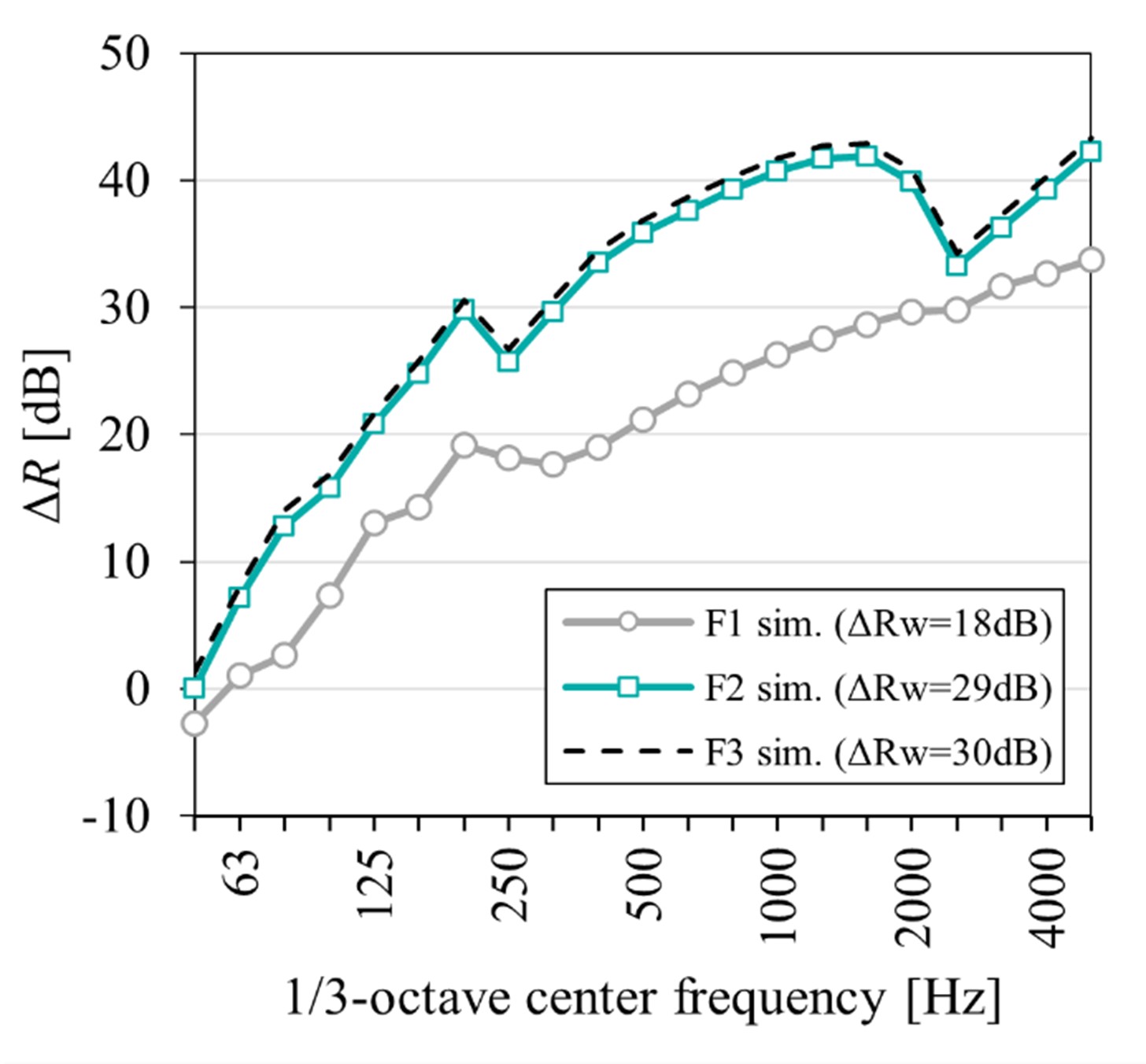
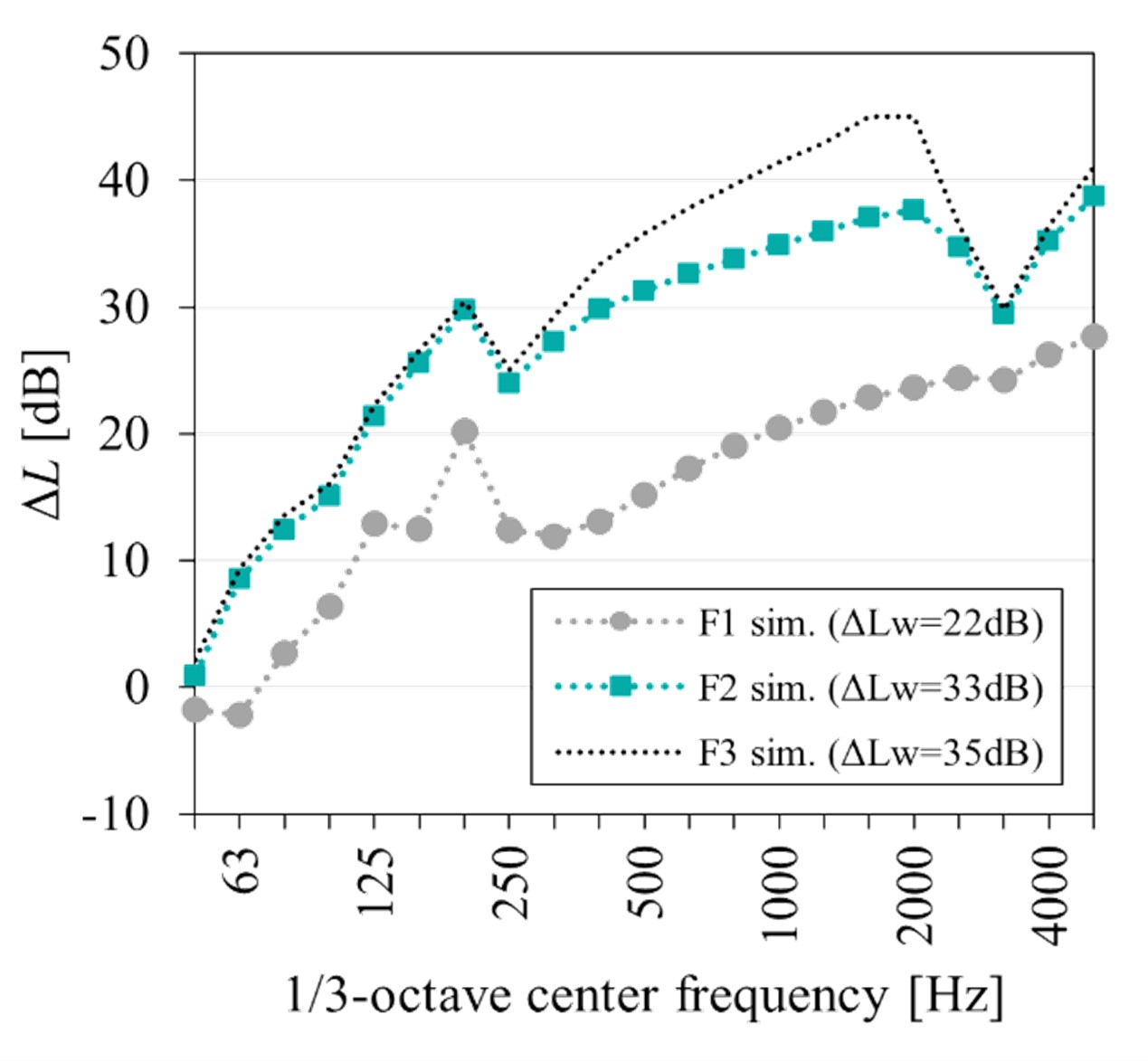
The FEM model, once validated, was used to compare the elastically suspended ceiling (F2) against a ceiling without any mechanical coupling (F3), this is to say a self standing ceiling with no acoustic hangers.
|
|
As it can be seen, the performance of the elastically suspended ceiling was close to the mechanically uncoupled ceiling. In airborne sound insulation there is a difference of 1 dB and in Impact noise 2dB.
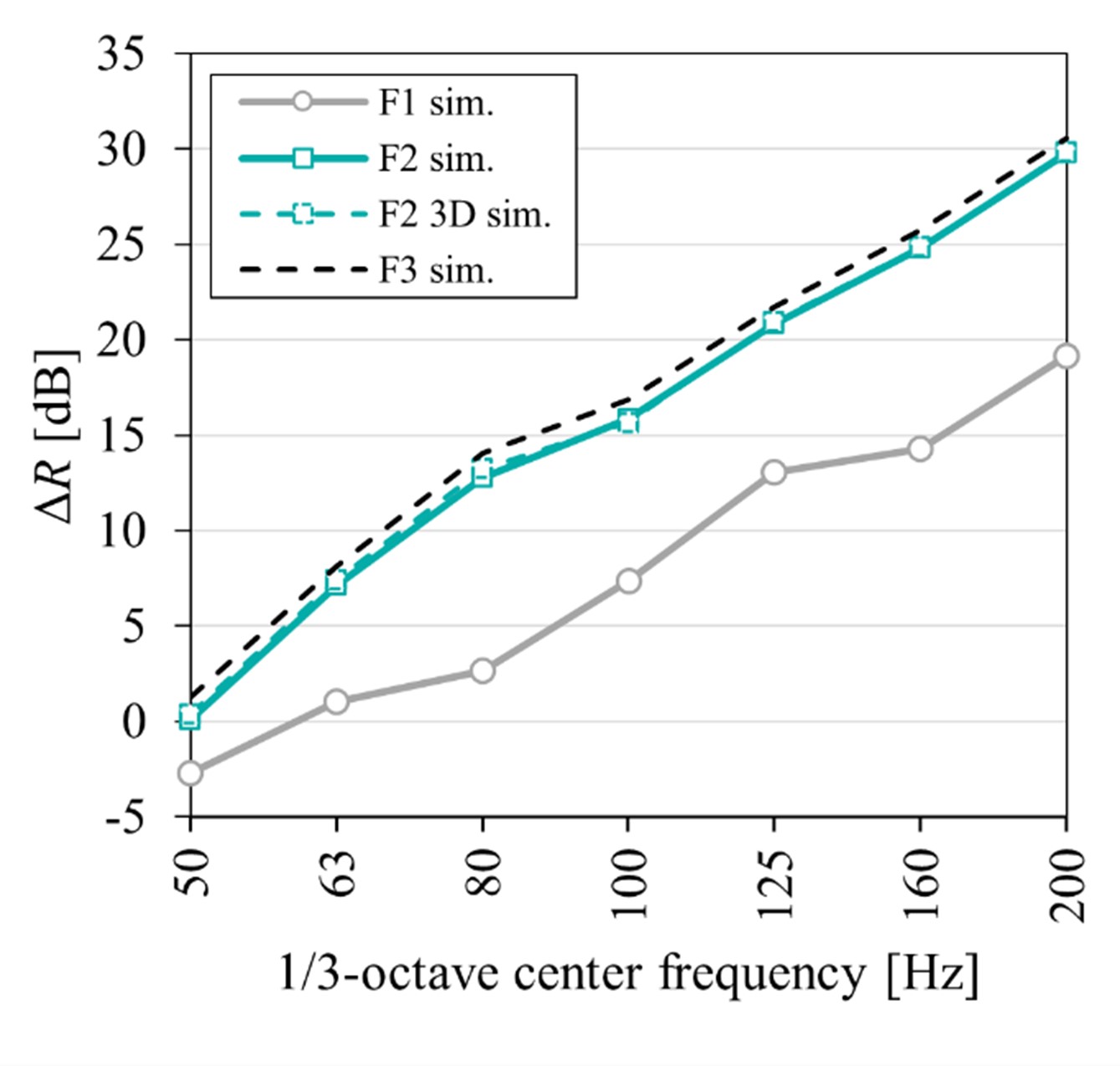
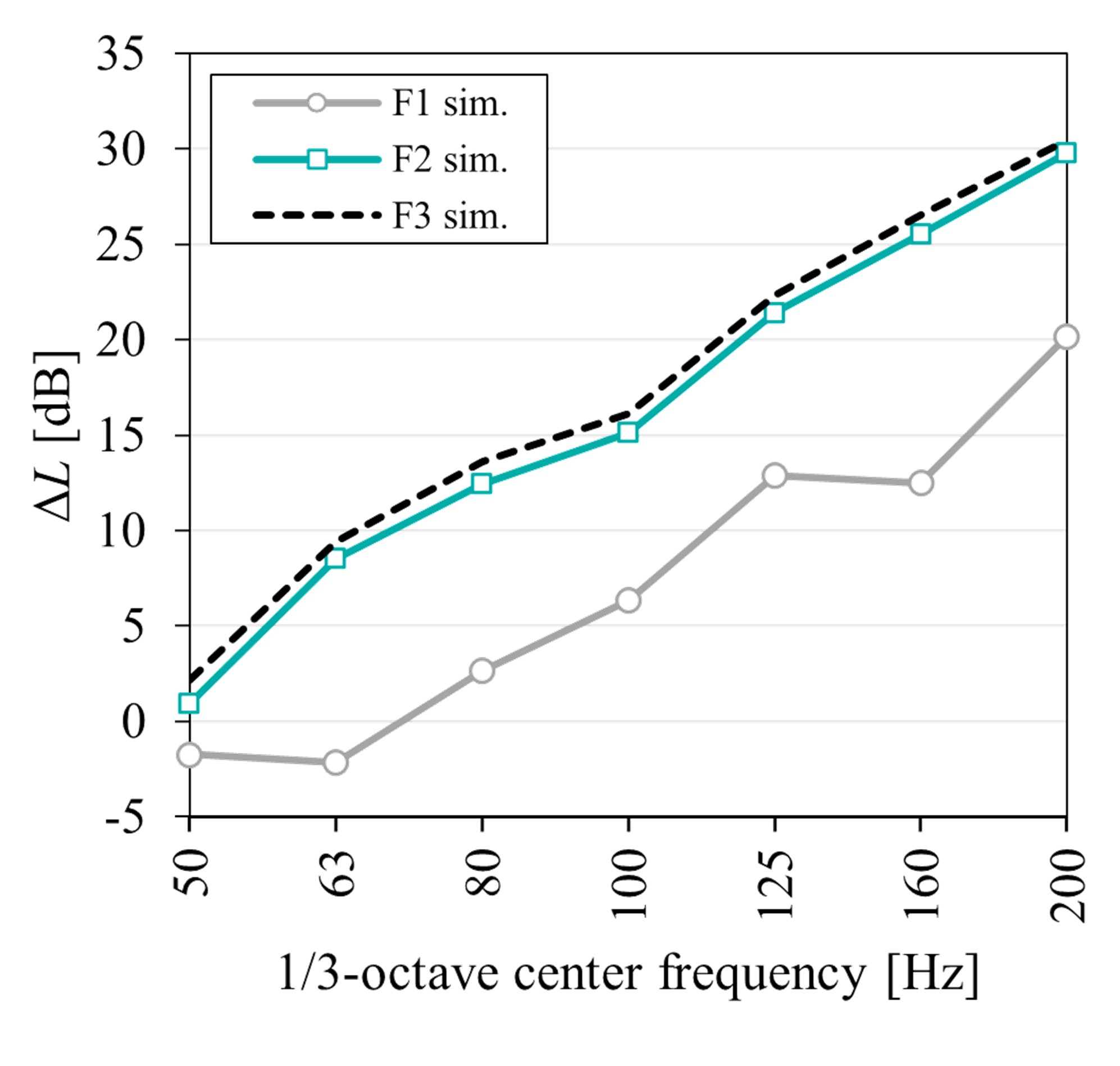
The calculation results from the FEM model were used to examine the performance of the ceiling at low frequencies, where again the elastically suspended ceiling was very close to mechanically uncoupled ceiling.
|
|
CONCLUSIONS
Using acoustic hangers is a beneficial method for improving airborne and impact noise insulation. The performance of an elastically suspended ceiling is very close to a mechanically uncoupled ceiling.