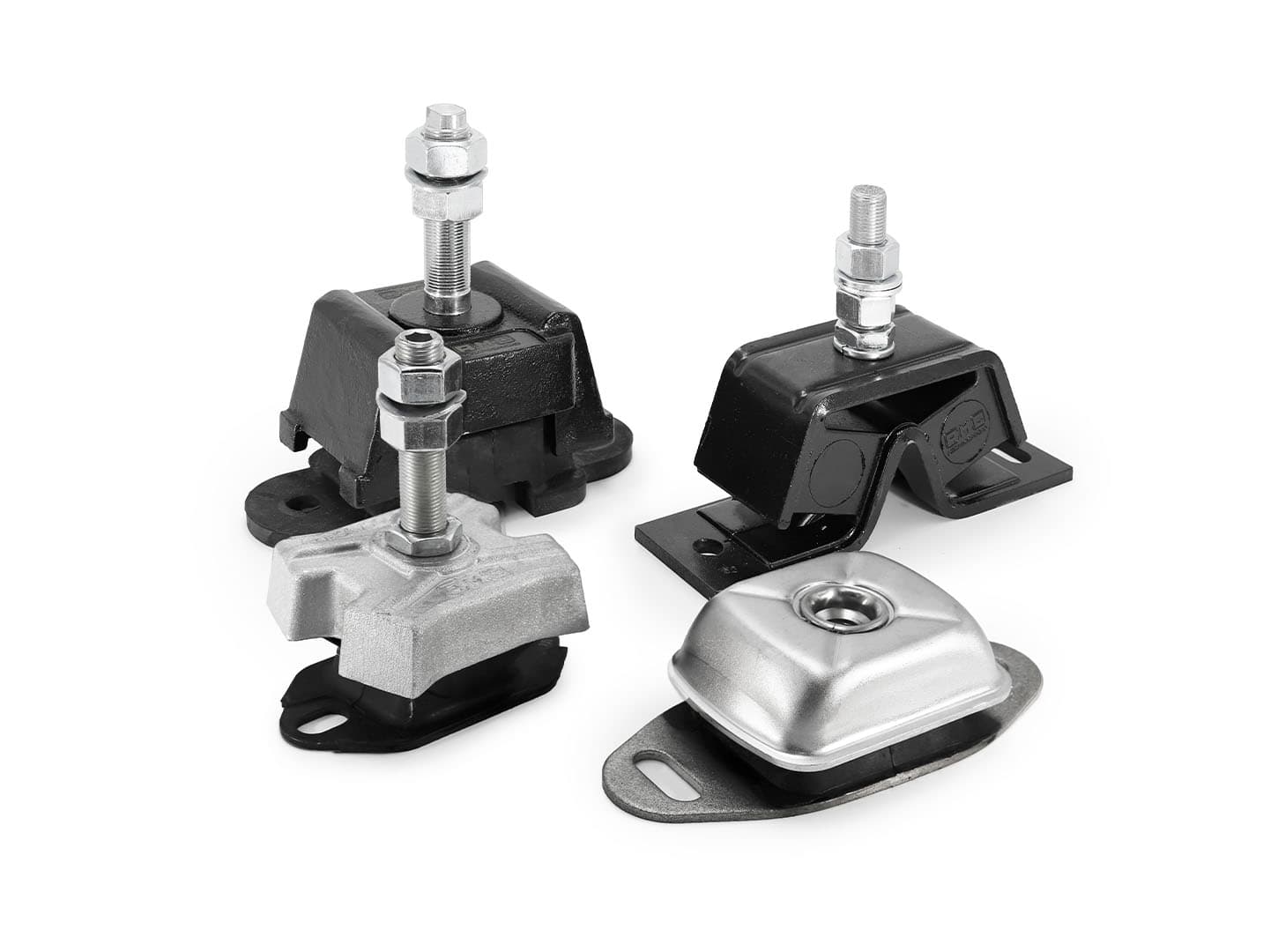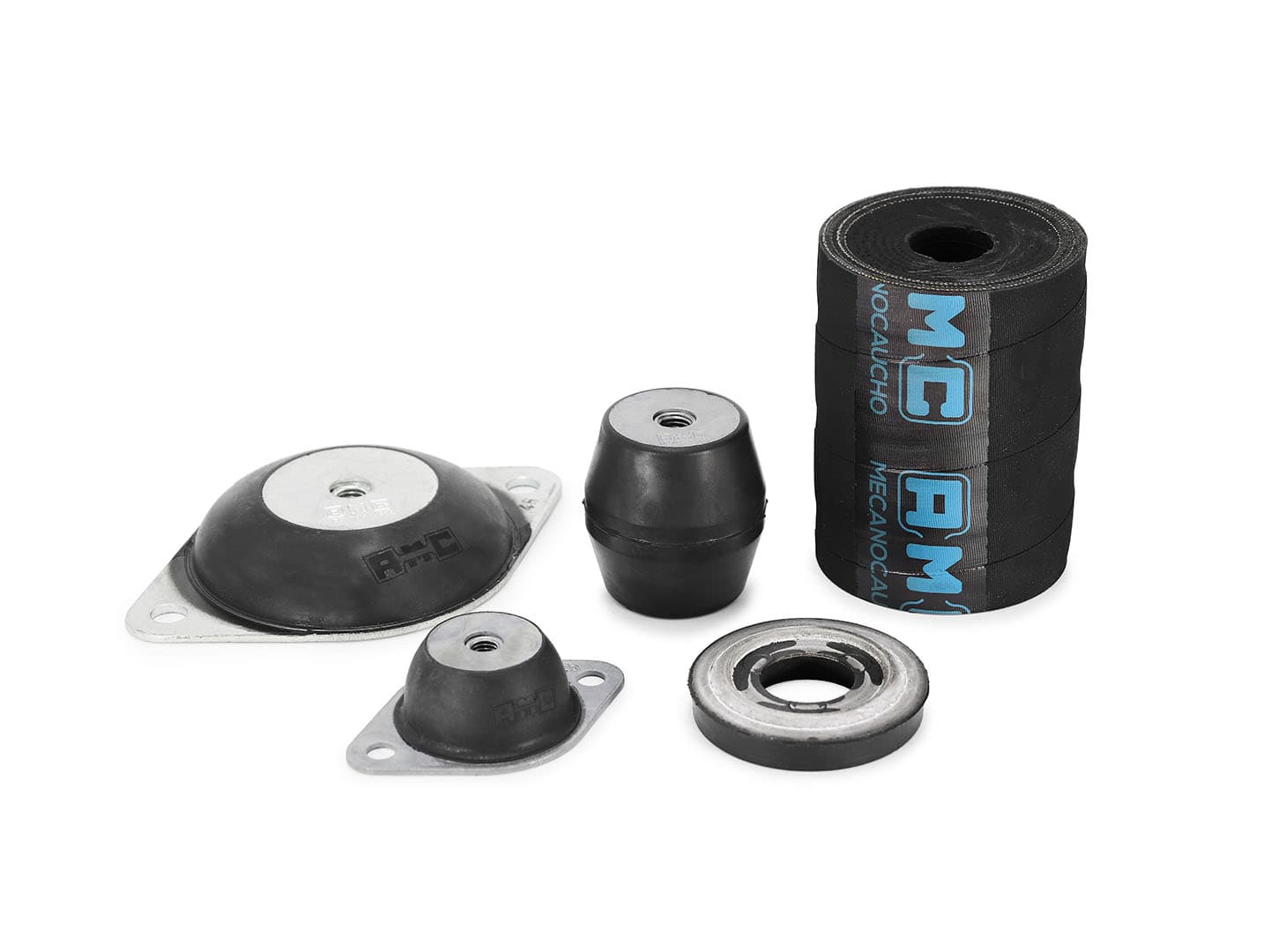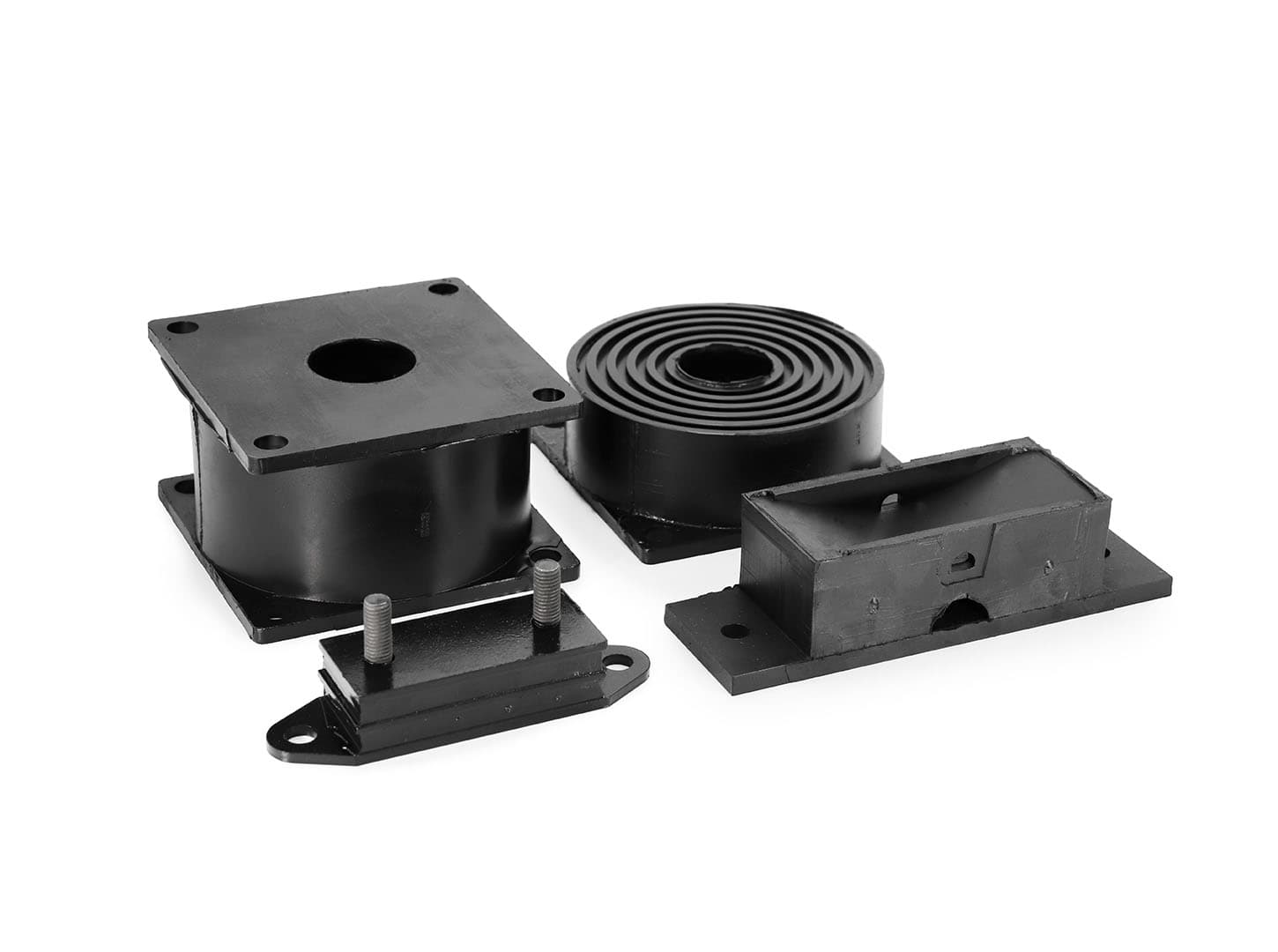
WHAT ARE VIBRATION ISOLATORS?
Vibration isolators are important elements for the reduction of noise and vibration in industrial machinery and equipment.
They isolate vibrations and noise from machinery whilst reducing the wear of their internal components. Vibration isolators can provide the lowest cost per reduced dB. They are highly efective and widely used in many applications. Typology and composition of vibration isolators
Vibration isolators are also often referred to as
AV Mounts, Vibration isolators or Vibration mounts. There are many different materials that are used as the resilient elements of vibration isolators depending on the application and performance required. The material used denotes the type of vibration isolator, each material has its particular advantages and also disadvantages.Plastic vibration isolators have performance characteristics like those of the rubber-to-metal type of isolators and are used in equivalent configurations. Their advantages include
low cost and outstanding uniformity; their disadvantages include a maximum operating temperature usually limited to 80ºC (180ºF).
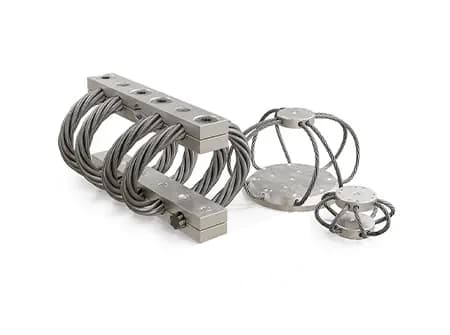
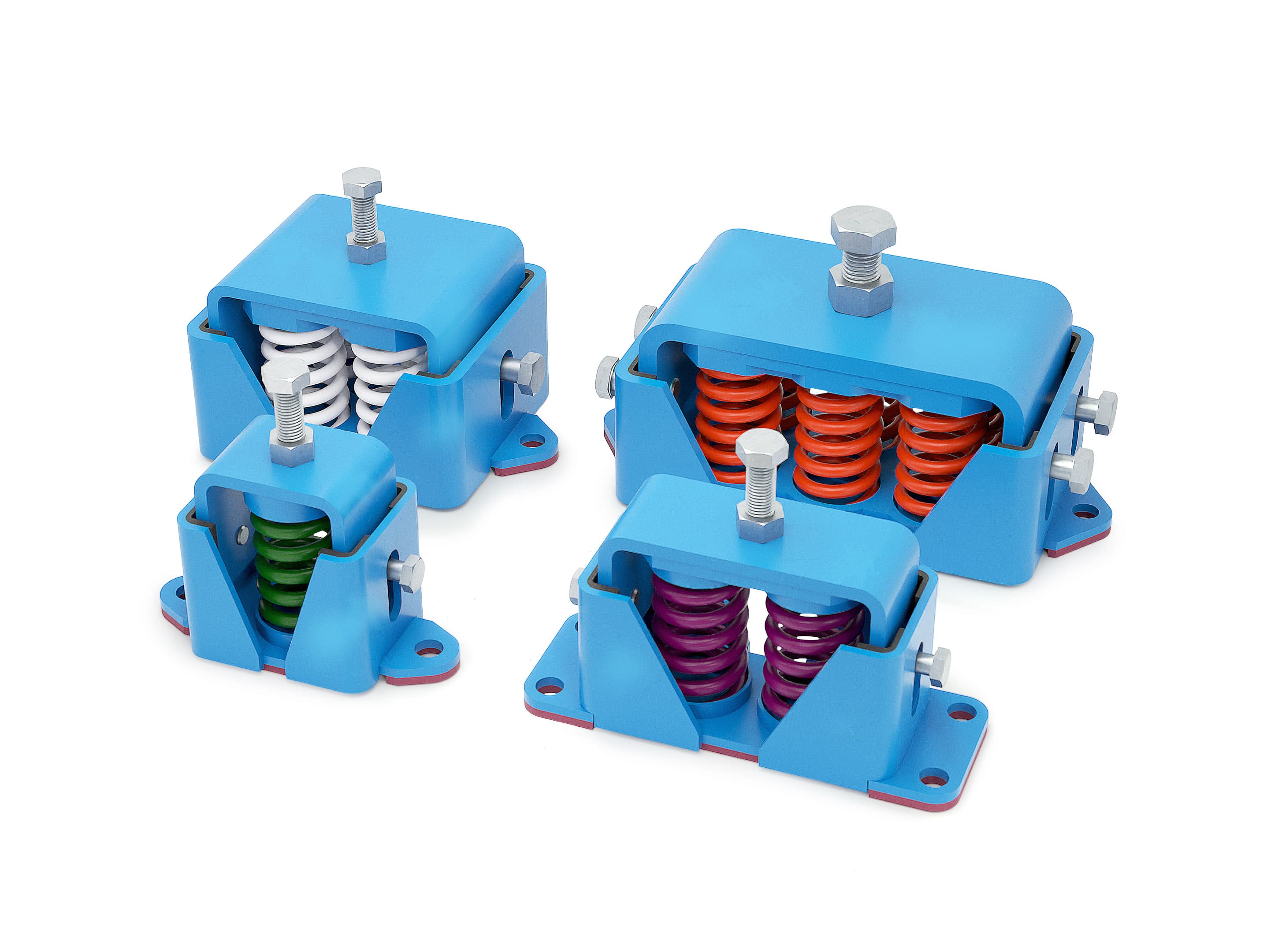
Metal springs are commonly used where large static deflections are required to give low system natural frequencies, they are also beneficial where high temperature or other environmental conditions make elastomers unsuitable. A disadvantage of a steel spring isolator is the lack of damping, care should be taken that the stability of the system is controlled during shock conditions. Pneumatic (air) springs provide advantages where low-frequency isolation is required; they can be used in many of the same applications as metal springs, but without certain disadvantages of the latter. This type of system is usually required for special applications which require a unique design.
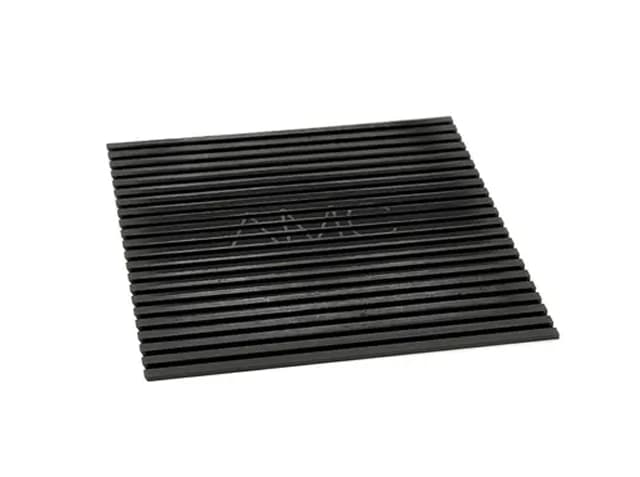
Resilient pads (i.e flat slabs) are fabricated of many materials including Neoprene, felt, fiberglass, cork, natural rubber and other compound materials. They lack
the adaptability of elastomeric parts, which are moulded to shape and adhered to metal inserts for easy application.
ELASTOMERIC VIBRATION ISOLATORS
The most commonly used type of isolator is fabricated with an
elastomeric material, i.e.
natural rubber or synthetic material. Such vibration isolators can sustain large deformations and then return to their approximate original state with virtually no damage. Elastomeric vibration isolators can be superior to other types of vibration isolators in the sense that for a given amount of
elasticity, deflection capacity, energy storage, and dissipation, they require less space and less weight. They also may be moulded into many different shapes and sizes to suit the performance required from each application, generally at a
lower cost than other types of vibration isolators.
Elastomers have exceptional deformability, They can be utilized for elongations of up to about 300 percent, with ultimate elongations of some elastomers to about 1000 percent. They may be stressed to as much as 1000 to 1500 psi (0.145 to 0.218 Pa) or more before their elastic limit is reached. Their great capacity for storing energy permits them to tolerate high stress, upon release of the stress there is virtually complete recovery from the deformation.
The inherent damping of elastomers is often useful in preventing excessive vibration amplitudes during a resonant condition, the amplitude is much lower than if for example a metal spring was used. Elastomeric materials can also provide excellent resistance to the transmission of noise through structures because of their relatively low specific acoustic impedance, an important consideration where acoustic requirements are a key factor.
Of the various elastomers, natural rubber probably embodies the most favourable combination of mechanical properties, such as minimum drift, maximum tensile strength and maximum elongation at failure. Its usefulness is restricted by its limited resistance to deterioration under the influence of hydrocarbons, ozone, and high ambient temperatures. Neoprene and butadiene (nitrile) exhibit superior resistance to hydrocarbons and ozone. Butadiene being particularly beneficial for applications involving relatively high ambient temperatures.
Silicone rubber is one of the costliest elastomers. Its properties are remarkably stable and it provides effective isolation over a very wide temperature range: -54ºC to 177ºC (-65 to +350ºF). By comparison, neoprene is limited in use to a range of about -20ºC to 93ºC (-4ºF +200ºF). The upper temperature limit depends on the properties of the particular compound, such as the degree of deterioration which is permissible as a result of continued exposure al high temperatures and the duration of exposure. For silicone, a temperature greater than 149°C (300ºF) is permissible for several hours. The outstanding ability of silicone elastomers to withstand extremes of temperature isoffset somewhat by their inferior strength, tear resistance and abrasion resistance.
Vibration isolators fabricated of elastomers are complex in behaviour because of their inherent viscoelastic nature (somewhere between that of a solid and that of a liquid). Their performance can be complex to determine due to their indefinite yield point, because their physical properties vary with time, temperature, and also environmental impacts. For example, rubber is a substantially incompressible material (it has a Poisson's ratio of approximately 0.5).
Therefore, the stiffness of a rubber element when it is strained in compression depends to a considerable extent on the area of the surface available for lateral expansion. In contrast, the stiffness of a rubber element in shear is substantially independent of the shape of the rubber member. A rough rule of thumb is that it can be assumed that the minimum likely compression stiffness of a given rubber spring is five times its shear stiffness. The maximum compression stiffness may be several times as great as the minimum value if lateral expansion of the rubber is constrained.